
Thinking about working with Susanna?
In this article, I share about the way I work, because it is not the way most people work, and if you are considering working with me, it is worth knowing in advance.
Not as a warning, more as an orientation.
There is a kind of session that feels productive but leaves you in exactly the same place. You share your thinking and the response comes back warm and affirming. "I love this." "You should be so proud." "This is really coming together."
And then you close the laptop and something sits slightly wrong. Nothing got sharper. The thing that felt almost-but-not-quite when you walked in still feels almost-but-not-quite on the way out, except now there is a layer of encouragement over it that makes the vagueness harder to locate.
I have been in that room. I know the feeling.
It is why I built my practice differently. Not because I think warmth is the problem, but because I think warmth alone is not enough. The most generous thing I can offer someone who has been building expertise for over a decade is an honest, precise account of what is working and what is not. And that requires a different kind of presence in the room.
So here is what that actually looks like.
1. I correct before I confirm.
This sounds harsher than it is in practice.
What it means is: If something is vague, generic, or missing the mark, I name that first. Not because I am indifferent to what you have built, but because sandwiching the problem inside encouragement tends to soften the blow and obscure the point simultaneously. And the point is usually the most useful thing in the room.
The reason this matters more than it might initially seem is that most experts arrive with framework ideas that are almost right. Almost ownable. Almost precise. The gap between almost and actually is often surprisingly small: a single word, a structural assumption, a framing that sounds familiar because it has been borrowed, consciously or not, from someone else's vocabulary.
That gap will not close if it goes unnamed.
I've noticed regularly that people feel the gap before they can describe it. They know something is slightly off. They just do not yet have the language for where the off-ness lives.
Naming it is not a criticism; it is often a relief.
2. Messy thinking is absolutely welcome here.
And structure is what makes it count.
Some of the most generative sessions I have ever had started with someone saying "I don't really know what I'm trying to say yet."
That is a fine place to begin. Better than fine, actually.
Ideas that arrive fully formed are often the ones that have been smoothed down so many times they have lost the interesting edges. The rough version, the half-formed one, the thought that exists somewhere between a voice note and a coherent sentence, that is where the real material tends to live.
So when you come in mid-thought, still processing something a client said, or circling an idea you cannot quite pin down yet, I will work with that. I am genuinely interested in the mess.
Great thinking needs both space and boundaries.
Space to roam, to follow an idea before you know where it leads, to sit with something unresolved. And boundaries to bring it into focus. A deadline is not a pressure tactic. It is a kindness. It is the thing that stops the circling and asks: what do you actually think?
This is why STUDIO is structured the way it is. There is a weekly question deadline, which gives your thinking a regular landing point. There is a monthly SPARK review, which means nothing drifts for too long without being examined. And the whole thing lives inside a three-month container, which is long enough to go deep and short enough to stay focused.
What shifts inside that rhythm is the expectation for the output.
Once an idea is in the room, once we have named it or drafted it or given it a shape, something in the process becomes more exacting. Every word gets examined. Every phrase gets held up to the question: is this the most specific true version of what you mean to say?
Not the most elegant version, or the most marketable version. The truest one.
The process moves from wide to sharp: Wide is how we find the territory. Sharp is how we make it yours.
And if you bring your messy thinking week on week, what emerges at the end of three months is a clear, structured, visual Authority Framework® that is unmistakably, completely, protectably you.
3. I treat your intellectual property as carefully as my own.
This one feels like it should go without saying, and yet...
I have seen framework names used in negative examples by people who genuinely meant no harm. I have seen trademarked terms replaced with near-approximations that slowly erode the distinctiveness they were built to hold. I have seen methodology descriptions that could, with remarkably minor edits, belong to three other practitioners in the same space.
None of that is carelessness, exactly. It is more like a slow drift, the kind that happens when language is treated as decoration rather than architecture.
Your intellectual property is not decoration.
It is the structure underneath everything else: the thing clients are actually buying when they invest in working with you, even if they would not use that language to describe it. The name, the framing, the proprietary language you have developed around your methodology, all of it deserves to be held with the same precision you bring to the work itself.
If a term gets misapplied, I say so. If the language has drifted from where it needs to be, we return to the original and rebuild from there. Not because I am precious about terminology, but because precision in language is what makes expertise ownable, and ownable expertise is the whole point.
4. If it could belong to anyone, we are not done yet.
There is a particular register that polished, impersonal writing falls into.
You have probably read it a hundred times without quite being able to name what felt slightly empty about it. It moves smoothly, uses the right vocabulary, hits the expected notes. And it could have been written for anyone.
When I notice output drifting toward that register, I name it. Not as a judgment, but as a navigation point. We have moved from specificity into approximation, and approximation will not do the job we need done.
The test I find most useful is a simple one: Would you know this was yours if you saw it without your name on it?
If the answer is a confident yes, wonderful. If there is a pause, we keep going.
Everything that represents your expertise in the world, your copy, your framework names, your positioning, the language you use when you talk about what you do, it all needs to be traceable back to you.
To your particular way of seeing, your specific experience, your genuine observation. The thing only you would say, because you are the only one who has stood exactly where you have stood.
Generic is not usually a writing problem. It is a thinking problem. When output is generic, it tends to mean we have not yet found the load-bearing idea underneath it. That is where we go next.
5. I am always thinking about the person on the other side of the page.
When I look at structure, sequencing, or language, the question I am asking is not "Does this sound good?"
It is "How does the reader move through this?"
Where will they pause? What assumption will they arrive with at this point that the copy has not yet addressed? What does this sentence make them feel before they finish reading it? If they leave the page here, what have they understood, and what have they missed?
This matters because most experts, quite naturally, write for the person who already understands the context. For the reader who already trusts the methodology, already knows why this approach is different, already shares enough of the worldview that the gaps fill themselves in.
That reader is a pleasure to write for. But they are also not the reader who needs convincing.
The person arriving from outside the bubble is working harder.
They are navigating unfamiliar language, making quick decisions about whether to stay or go, building or withdrawing trust with every paragraph. The structure needs to meet them in that reality, not assume they will do the navigating themselves.
When we look at a sales page together, or a framework description, or a sequence of emails, this is the lens I bring. Not: is this accurate? But: does this take the right person, by the hand, from where they are to where they need to be?
6. We go through complexity before we earn the simple version.
The clean, compressed version of an idea is what everyone wants to arrive at. And I want to get you there. But I do not jump to it without reasoning.
We work through the layers first: The nuance, the exceptions, the edge cases, the things that are almost true but not quite, the things that hold in some contexts but buckle in others. We sit with all of that, examine it, and then find what is load-bearing at the centre.
That moment, when the full depth of a body of work compresses down to its essential form, is one of my favourite things to witness. It is the moment a client stops explaining their methodology and starts simply saying it. There is a quality shift that is almost physical. Something that was complicated becomes clear, not because it was simplified, but because it was understood deeply enough to be distilled.
This is what I call Transfer Integrity: The quality that ensures your framework carries the same insight to the person learning it as it holds for you. When it is present, your clients feel what you feel when you teach it. When it is absent, something gets lost in the gap between your intention and their experience.
That quality cannot be shortcut. The depth has to be earned before the simplicity can be trusted.
7. Some questions are meant to stay open for a while.
This is perhaps the one that surprises people most.
There is a pressure in any working session to leave with answers. Resolution feels like progress. And sometimes it is. But sometimes, reaching for resolution before the ground is ready produces the wrong answer at high confidence, which is a particular kind of problem, because a wrong answer that sounds certain tends to calcify.
It gets written into the framework, embedded in the positioning, repeated in client conversations until it becomes part of the identity of the business. And then it is very difficult to undo, because it is no longer recognisable as a mistake. It just feels like how things are.
I share this from learning from my own mistakes, in past articles I have admitted that what I said with certainty last year is not the case this year, my initial guiding name for a principle wasn't right. A year on, in writing my book, Framework Thinking, the real name emerged - in this case it was the 'Framework First Principle'. There is no shame in developing ideas, it's to be celebrated.
When I notice a question that needs more time, more client observation, or more evidence before it can be answered honestly, I name it and hold it. I will tell you what I think we need to find out before we can answer it well. That is not a deflection. It is the most useful thing I can offer.
The frameworks that hold up years down the line are the ones where the open questions were taken seriously, given time, and answered only when there was something real to answer with.
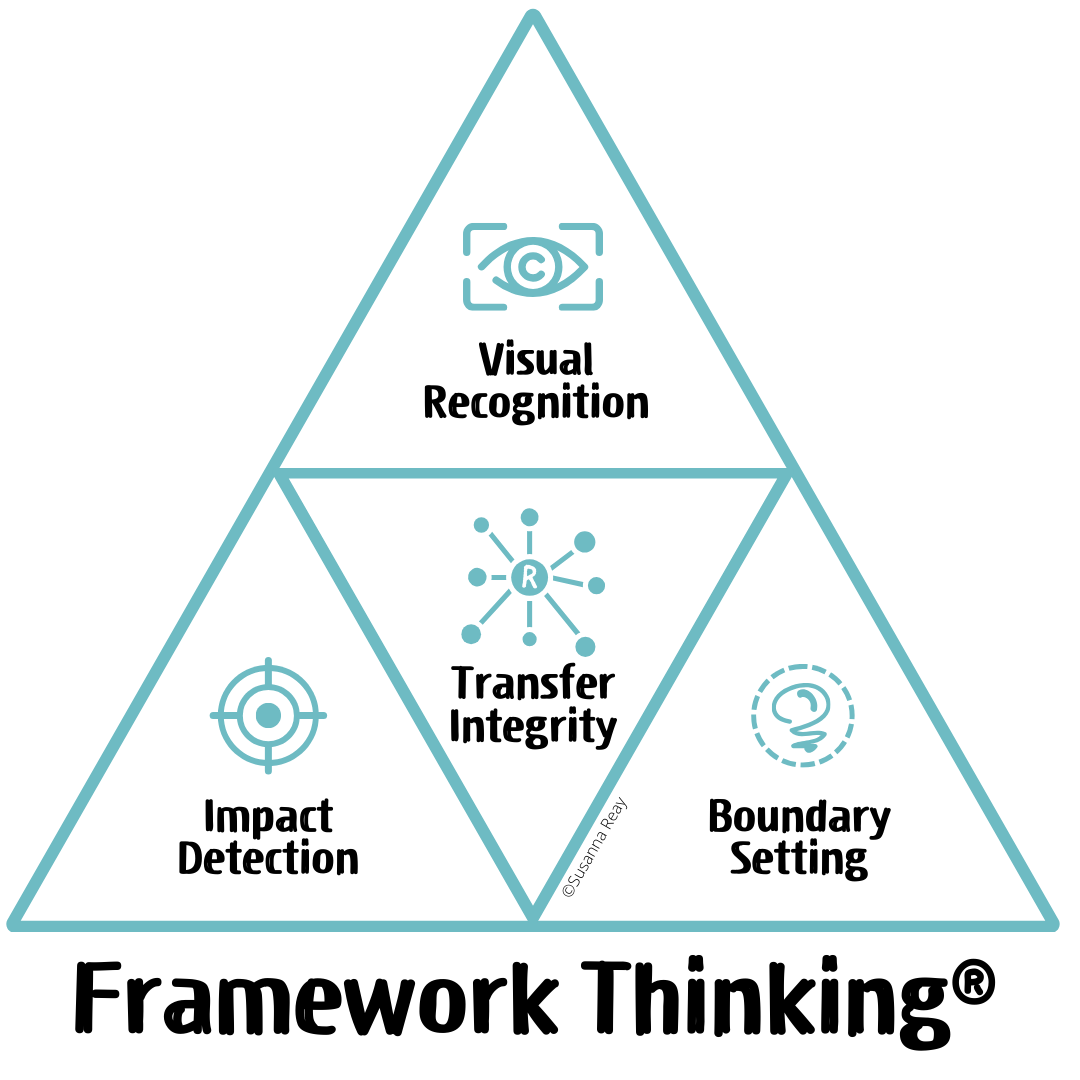
Framework Thinking® at work
If you are already familiar with Framework Thinking, you may have noticed something in the seven principles above. Each one is an expression of the four elements that sit at the heart of every great framework: the same elements that make expertise ownable, transferable, and unmistakably yours.
Visual Recognition
The distinctiveness that makes your framework immediately identifiable as yours.
Impact Detection
Understanding exactly how your framework lands for the person receiving it.
Boundary Setting
The container that gives thinking enough shape to produce something real.
Transfer Integrity
Ensuring the insight you hold arrives intact in the person you are teaching.
This is what it looks like when a methodology becomes a practice rather than a concept. Not something you teach, something you live inside.
This is STUDIO
STUDIO is a three-month guided working environment for established coaches, consultants, and expert service providers who are ready to do this work properly.
Not a course to move through, nor a community centred on connection and encouragement, though both of those things do happen. A working space, shaped by the seven principles above, where your intellectual property gets the rigorous, curious, precise attention it deserves.
The rhythm is simple: a weekly question to keep your thinking moving, a monthly SPARK review to examine what is emerging, and a three-month container that holds it all. Space to think properly. Boundaries that make the thinking count.
If you have spent years building expertise and you know the thinking is there, but it is not yet structured in a way that makes it unmistakably, protectably yours, this is the space where that changes. Bring the mess week on week, and by the end you will have a clear, structured, visual Authority Framework® that could only ever belong to you.
I would love for you to read the full detail and see whether it feels like the right room.
