
What 252 Experts Revealed About How Authority Actually Develops
The data from the Natural Authority Style Assessment tells a story most business owners have never been told — and it might be the most useful thing you read about your positioning this year.
There is a particular kind of frustration that high-achieving experts carry quietly.
It is not the frustration of not knowing enough. It is the frustration of knowing too much, across too many areas, to land cleanly on a single clear position. Every time you try to articulate what you do, it comes out differently depending on who is asking. You are brilliant in the room and strangely invisible in the market. You adapt effortlessly, deliver consistently, and somehow still feel like you have not quite arrived at the thing that is unmistakably, unambiguously yours.
If any part of that resonates: you are not behind. You are in a phase that 37% of the experts in this study were also navigating when they took the Natural Authority Style Assessment.
And the data shows, clearly, where they were heading next.
The finding that reframes everything
When 252 coaches, consultants, and expert practitioners completed the Natural Authority Style Assessment, the most common result was not Hummingbird, Owl, Squirrel, or Dolphin.
It was Chameleon. At 37.7%, it was the single largest group in the dataset by a significant margin.
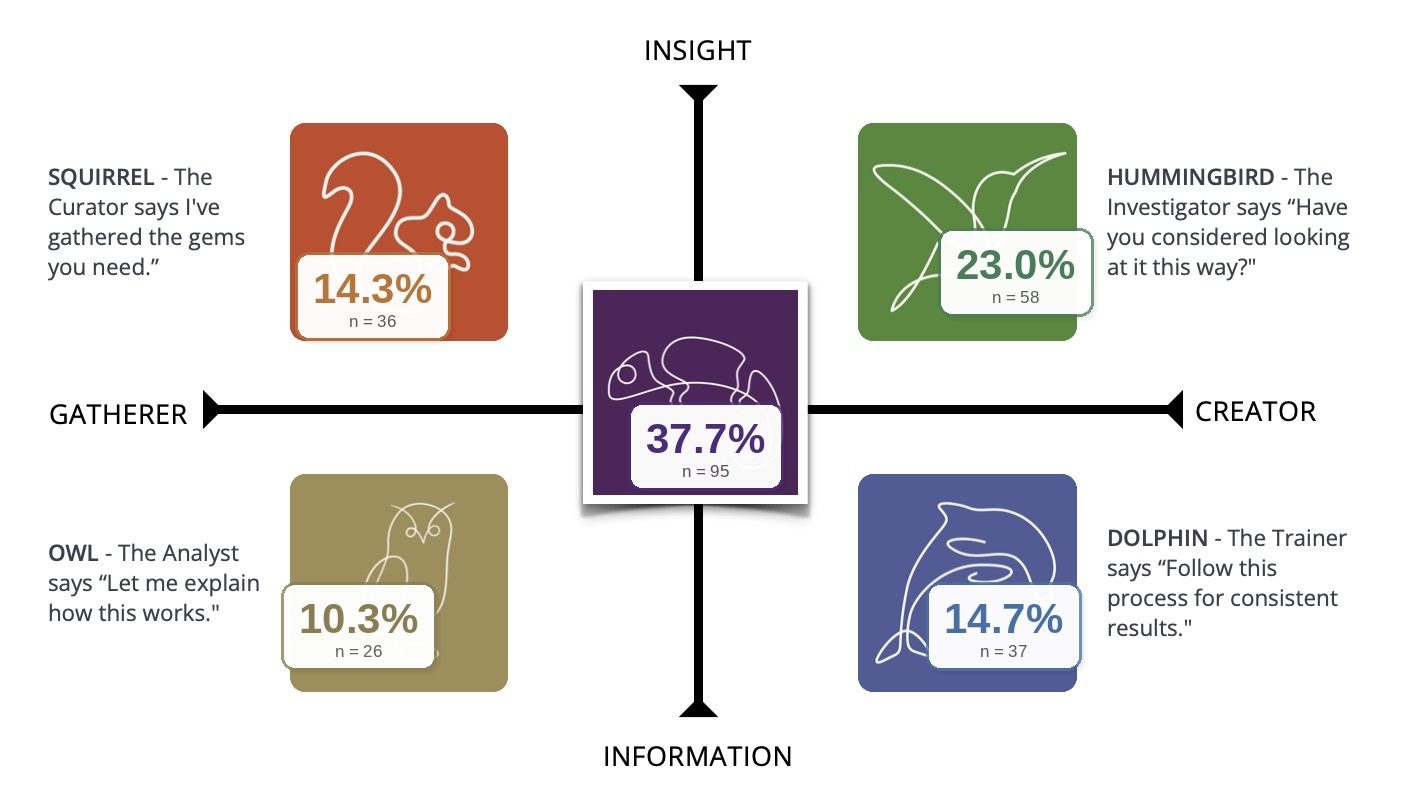
Here is what that means — and what it does not mean.
It does not mean these respondents lack a natural authority style. It means they have not yet organised their strengths into one.
The Chameleon result describes a phase, not a personality type. It is the period in an expert's development when capability is real and range is wide, but the cohering thread — the thing that makes your work unmistakably yours — has not yet been excavated and named.
That is a very different problem from not having expertise. It is the problem of having too much of it, too undifferentiated, to stand out in the way your work deserves.
The Chameleon phase can be exciting: you are building, experimenting, discovering what you actually love and what you are genuinely exceptional at. But it can also trap you for years. When it does, the cost is not just commercial. It shows up in the exhaustion of perpetual adaptation, the quiet stagnation of delivering excellent work that never quite compounds into recognised authority, and the slow erosion of the satisfaction that brought you into this work in the first place.
The open answers from quiz respondents confirmed this. Across hundreds of responses, the same emotional register appeared: the feeling of being brilliant one-to-one but invisible to the wider market; the weight of explaining yourself differently every time; the sense of yearning for something more coherent, more ownable, more lasting.
Takeaway: If your Chameleon result stung a little, that is information worth sitting with. The sting usually means you already knew, and you are ready for what comes next.
The direction is already showing — you just need to know where to look
The most important finding in this analysis is not the 37% headline. It is what happens when you look one layer deeper.
Every quiz result includes a secondary score: the style that sits just beneath the primary result, the one that scored highest after the leading archetype. For Chameleon respondents, that secondary score is not random. It clusters by industry in ways that reveal something significant about where expertise naturally develops within each sector.
In other words: your direction of travel is already visible in your scores. You are already heading somewhere. The work is not to choose a style, it is to recognise the one that is already pulling you forward.
Life and Leadership Coaches
Life coaches in the Chameleon phase are heading toward Squirrel in 58% of cases, with most of the remainder heading toward Hummingbird. Almost none are heading toward Owl or Dolphin.
This makes deep sense. Life coaching is a field built on accumulated wisdom — on gathering the right insight, the right story, the right reframe for the right person at the right moment. The Squirrel's instinct is precisely that: curating across wide and varied sources, and synthesising them into something cohesive and purposeful. Life coaches in the Chameleon phase are not missing a methodology. They are sitting on a rich collection of one that has not yet been named.
Leadership and career coaches follow a similar Squirrel trajectory, but with a stronger Hummingbird secondary: the perspective-shifting, assumption-challenging quality that distinguishes the coaches in this group who are heading toward an investigative, reframe-led authority style. Their framework, when it crystallises, will be built around a distinctive way of seeing rather than a comprehensive system for doing.
Takeaway: If you are a life or leadership coach in the Chameleon phase, your authority is not missing. It is in your collection. The question to sit with is: what is the consistent filter through which you select what goes in and what stays out? That filter is your framework, waiting to be claimed.
Business Coaches
Business coaches in the Chameleon phase produced the most surprising finding in the entire dataset.
Unlike every other coaching sector, their secondary scores split almost equally between Squirrel and Owl — with Hummingbird close behind. This means business coaches who have not yet settled into a clear authority style are carrying a notably stronger analytical undercurrent than their peers in life or leadership coaching.
The Owl tendency — grounded in rigorous thinking, research-informed positioning, and the ability to make complexity clear — is present in this group in a way it is not elsewhere in the coaching world. That analytical quality is not a divergence from coaching. It is the beginning of a distinctive authority positioning that most business coaches do not yet recognise as theirs.
Takeaway: If you are a business coach in the Chameleon phase, pay close attention to the moments when you find yourself wanting to go deeper into the evidence, the model, the systemic pattern underneath the presenting problem. That instinct is not overthinking. It is your authority style asserting itself.
Business and Marketing Consultants
Consultants in the Chameleon phase divide clearly between two directions: Squirrel and Dolphin.
The Squirrel-leaning consultants are synthesisers — gathering intelligence across fields and markets and producing insight that is greater than the sum of its parts. The Dolphin-leaning consultants are systematisers — developing repeatable delivery frameworks that produce consistent results regardless of who is in the room.
Both have working methodologies. Neither has a named one. The distinction between a methodology you operate and a methodology you own is precisely what Framework Thinking® is designed to close.
Takeaway: Look at your client work over the last twelve months and ask honestly — are you delivering different work each time, or the same work in different contexts? If it is the latter, you already have a framework. You are just not charging for it by name yet.
Health & Wellness Practitioners
The most distinctive pattern in the entire Chameleon analysis belongs to health practitioners.
Every single one in this group is heading toward Owl or Dolphin. Not one is heading toward Hummingbird or Squirrel.
This is not a coincidence. Health and wellbeing fields demand rigour as a baseline: research literacy, evidence-based practice, and structured protocols are the professional norm. What this means in terms of authority development is that health practitioners' invisible strengths — the ones they cannot yet see as distinctive — are almost always analytical or systematic in nature. The research they take for granted is authority in another sector. The treatment protocol they follow instinctively is a proprietary framework waiting to be named.
Takeaway: If you are a health or wellness practitioner who feels like your expertise is not quite packaging itself clearly, look to your evidence base and your diagnostic process. The rigour you were trained in is your most underutilised authority asset. It just needs the language of Framework Thinking® to become visible.
Why the pattern splits by industry
The clustering of Chameleon directions by sector is not random. It reflects something important about how expertise develops.
Your industry shapes which of your strengths get exercised first, which capabilities your clients actively reward, and — crucially — which aspects of your expertise become so normalised that you can no longer see them as distinctive.
Life coaches develop their curation instinct because their clients need the right thing at the right moment, not a comprehensive system.
Consultants develop their systematising instinct because their clients need results that hold after the engagement ends.
Health practitioners develop their research instinct because their professional standards demand it — and that rigour, invisible to them, is authority to everyone else.
The Chameleon phase is not the absence of a style. It is the presence of too many undifferentiated strengths, accumulated in the specific shape of your sector's demands, not yet organised into something that is unmistakably, ownably yours.
That is not a gap. That is the raw material of a framework.
The route forward: what the data points to
Across all 252 respondents, the secondary score patterns reveal a consistent truth: the direction of an expert's authority development is already present in their work. It is not something to invent. It is something to uncover.
The four named authority styles each have a distinct relationship with Framework Thinking®:
Squirrel authority is built by claiming the lens behind the curation — making the selection filter explicit and giving it a name and a structure that others can follow.
Hummingbird authority is built by compressing a distinctive perspective into a visual that holds the reframe without needing the expert in the room to explain it.
Dolphin authority is built by naming the transitions, not just the stages — identifying where transformation actually happens in the delivery sequence and making that visible.
Owl authority is built by trusting the shape — by compressing analytical depth into a form that travels without the footnotes, and letting the rigour speak through the structure rather than the explanation.
In each case, the work is the same at its root: excavating what is already there, giving it form, and making it ownable.
Where to go from here
If you have already taken the Natural Authority Style Assessment and landed on Chameleon: go back to your results. Your secondary score — the style sitting just beneath the surface — tells you which direction your authority is already moving in. That is your starting point for the SPARK Process.
If you have not yet discovered your natural authority style, the quiz takes five minutes and the secondary score is as important as the primary result.
Discover your natural authority style → susannareay.com/authority-style/
And if you are ready to move from insight to implementation: the SPARK Process — Self, Premise, Art, Reach, Kudos — is the complete framework for turning your natural authority style into intellectual property that scales, my book covers this in depth.
Framework Thinking®: Sketch. Scale. Be Sought. is available now on Amazon.
Chapter 5, SELF: Escaping the Chameleon Problem, was written precisely for the 37%.
