
Updated Thinking February 2026. Originally published May 2025 as “The Authority Inversion Principle.” My thinking has evolved, the principle is sharper. Here is the current version.
After twenty years of building my own consultancy and working with hundreds of coaches, consultants, and expertise-led founders, I have noticed a pattern that separates those who struggle from those who compound their authority over time.
The difference is not talent, experience, or even results.
It is structure.
The experts who thrive have something load-bearing at the centre of their business: a framework that captures how they create transformation. The experts who struggle are often doing brilliant work, but nothing about it travels, compounds, or scales without their constant presence.
This observation became what I now call The Framework First Principle, and it has fundamentally changed how I approach business development, both for myself and for the ambitious experts I work with.
The Framework First Principle in brief:
Authority compounds only when intellectual property is structured before it is amplified. Visibility magnifies what is load-bearing. Without a framework, it magnifies effort.
Most experts follow the conventional path: content, visibility, more content, more visibility, hoping authority follows. Nothing compounds. Everything starts from scratch.
The Framework First Principle establishes a different growth dynamic: structure your IP first, then let visibility amplify something worth amplifying. This applies whether you run a small, intimate practice or a global consultancy. Frameworks create optionality, not obligation.
Think of it as the difference between a Japanese Maple in open soil and one cultivated as a bonsai. Both are impressive. Only one creates an ecosystem.
~ Susanna Reay, creator of Framework Thinking®
The Expertise Paradox
We are living in an age of unprecedented opportunity for expertise-based businesses, yet paradoxically, it has never been harder to stand out. The digital landscape is saturated with experts, all using remarkably similar approaches to chase the same attention.
The result is a peculiar phenomenon where brilliant practitioners find it increasingly difficult to command premium fees or attract ideal clients consistently, despite doing exceptional work.
As I reflected on my own journey from struggling consultant to recognised authority, I realised something: most of us have been building our expertise businesses in the wrong order.
The Conventional Path
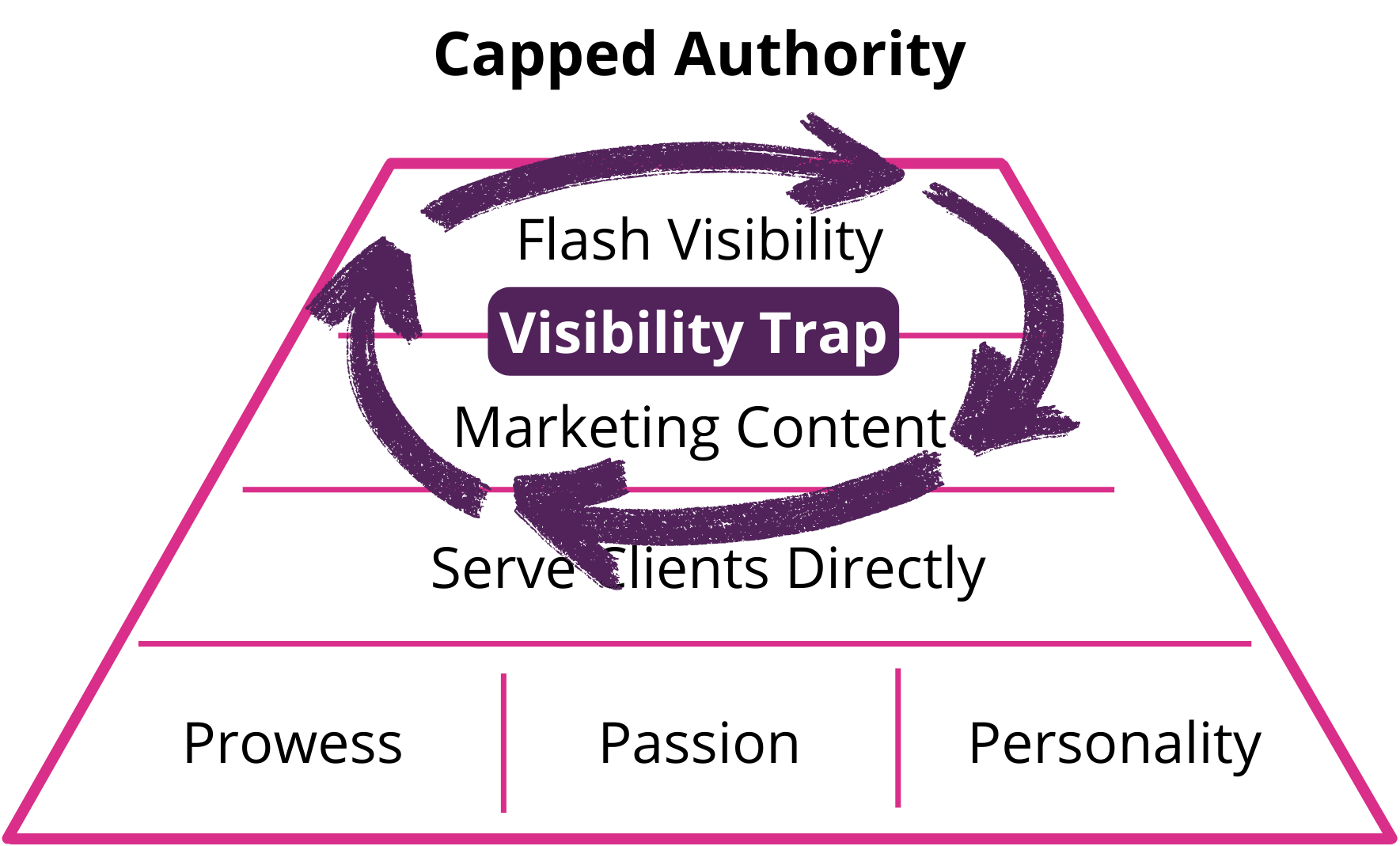
The traditional approach to establishing yourself follows what I think of as the visibility-first model: create endless content for visibility, network aggressively for credibility, collect testimonials as proof, and eventually develop your methodology once you feel “established enough.”
This has become the default path. I followed it myself for years, feeling perpetually exhausted by the content hamster wheel and constantly measuring my follower counts against others in my field.
The problem is not that these activities lack value. They certainly have their place. The issue is that without a solid intellectual foundation beneath them, they leave you constantly chasing external validation, competing on the same platforms as everyone else, and struggling to justify premium pricing.
Nothing compounds. Every post starts from scratch. Every client conversation begins with “let me explain what I do.” Every opportunity requires your full presence and energy.
I call this the visibility trap: the seductive illusion that being seen equals being valued.
The Framework First Principle
What if we reversed this? What if, instead of starting with visibility, you began with your intellectual foundation?
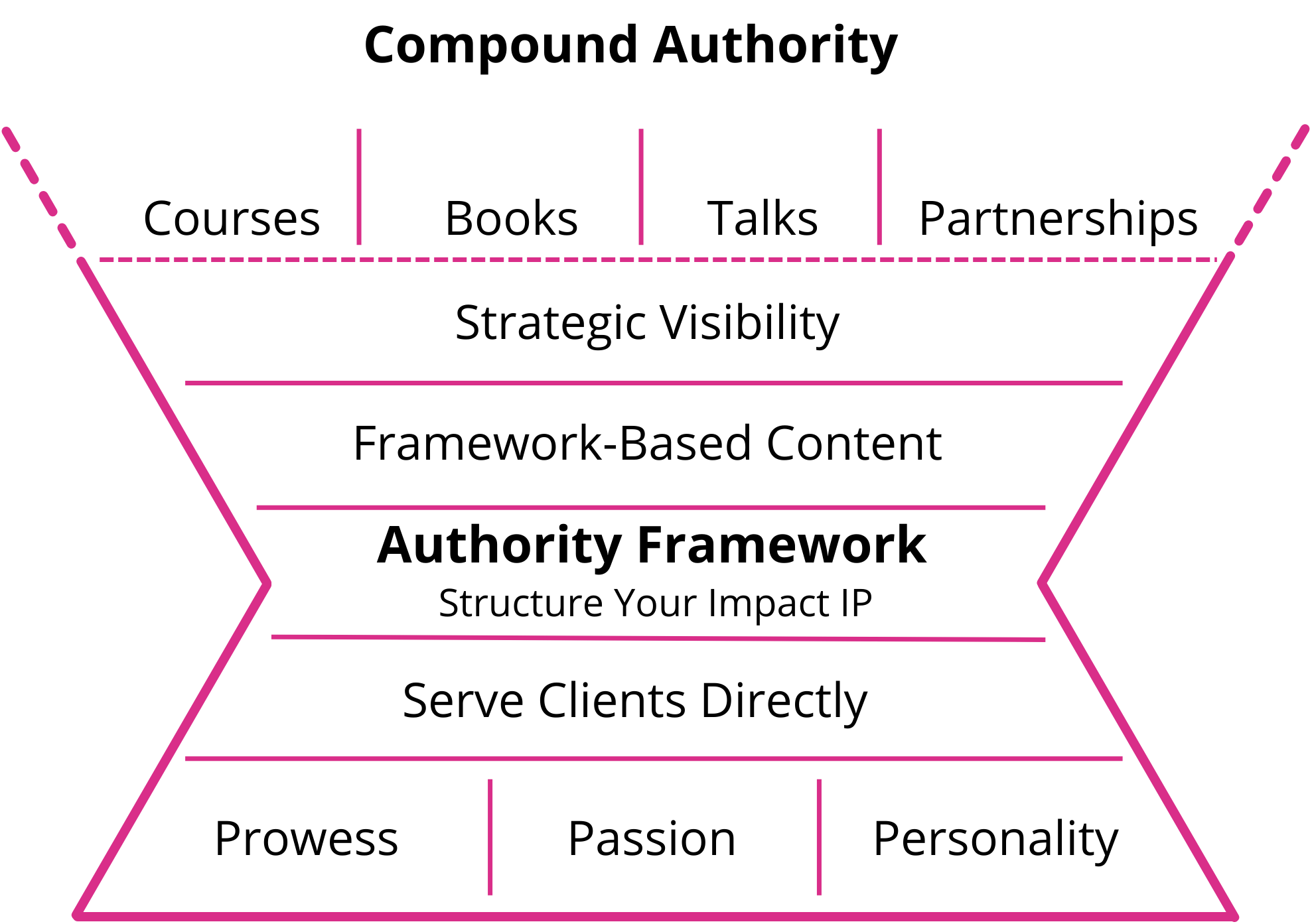
The Framework First Principle states that authority compounds only when intellectual property is structured before it is amplified. Visibility magnifies what is load-bearing. Without a framework, it magnifies effort.
When I first implemented this shift in my own practice, the transformation was immediate. By developing my signature framework before seeking wider visibility, I created a gravitational pull that attracted precisely the right clients: those who valued my specific methodology and were willing to invest accordingly.
The shift looks like this:
Structure your IP → Create framework-driven content → Use strategic visibility → Let authority compound
This is not a style preference. It is a growth dynamic.
The Maple and the Bonsai
I think of it this way.
A Japanese Maple planted in open soil develops deep roots, reaches its full height, and eventually sends out seeds that create new trees. The same species, cultivated as a bonsai, is beautiful, precise, and admired. It requires constant tending and will never reproduce on its own.
Both are magnificent. But only one creates an ecosystem.
The expert without a framework is the bonsai: impressive, sought-after, delivering genuine transformation, but capped. Every client requires their direct involvement. Every explanation starts from scratch. Growth is tied to their calendar, their energy, their personal capacity. Not because they chose this, but because no one showed them another way.
The expert with a framework is the maple. Their intellectual property has roots. It is structurally sound. It can travel through a workshop, a talk, a book, a team training session. They may choose to keep their practice intimate, but their ideas still have reach.
The framework is the open soil.

This Is Not About Scale
Here is where my thinking has evolved most significantly since I first wrote about this principle.
The Framework First Principle is not about choosing between a boutique practice and a global consultancy. It is about building the intellectual architecture that gives you agency over your own growth, whatever that looks like.
The majority of experts I work with run small but mighty businesses. They are not chasing empires. They want clarity, premium positioning, and clients who arrive already understanding their approach.
Frameworks deliver all three, regardless of your business size.
Your value becomes legible. The right clients find you because they can see and articulate what you do. Referrals get easier because your framework gives people language to describe your work.
Your positioning becomes premium. A visible methodology signals depth that generic expertise descriptions never can. You stop competing on personality and start owning intellectual territory.
Your future becomes optional. The group programme, the workshop, the book, the speaking engagement, the licensing agreement: all become possible because the IP exists in structured form. You may never pursue any of them. But you could. The framework creates the optionality, not the obligation.
That last point is what my clients actually experience. They come for clarity. Then six months later they realise they could run a workshop from their framework. Then someone asks if they can license it. The framework created possibilities they did not plan for.
What Changes When You Put Frameworks First
Through working with hundreds of experts, I have seen five consistent shifts when the framework comes first.
- It liberates you from the content treadmill. When you have a framework at your core, every piece of content connects to something larger. My own content creation time reduced by 60% while engagement increased, because each piece reinforces a coherent body of work rather than starting from scratch.
- It removes you from the comparison game. When you own a unique methodology, you are no longer competing with everyone offering similar services. You have created intellectual territory where you are the only logical choice.
- It justifies premium fees naturally. When clients see a systematic approach rather than generic expertise, they pay significantly more for access to your proprietary methodology. I have helped consultants double and triple their fees through this alone.
- It pre-qualifies your clients. When your framework addresses specific problems in a distinctive way, it naturally resonates with the exact people you want to work with. The clarity of your methodology does the filtering before anyone picks up the phone.
- It creates compound growth. Your framework becomes the foundation for whatever you choose to build next: whether that is a more focused one-to-one practice, a group programme, a book, or a speaking career. The structure supports all of it.
My Own Journey With This Principle
I discovered this through painful experience. For years, I exhausted myself creating content across every platform, networking at every event, constantly chasing the next testimonial. Despite working relentless weeks, my income plateaued and I felt increasingly commoditised.
The breakthrough came when I stepped back from the visibility hamster wheel and invested three months developing what became the SPARK Process®. Initially, I worried about losing momentum by reducing my content output. The opposite occurred.

When I returned to visibility activities with the framework as the foundation, everything changed. Potential clients no longer asked “What do you do?” but “Can you tell me more about your framework?” Pricing objections virtually disappeared as conversations shifted from my hourly rate to the value of accessing a proprietary methodology.
I was the bonsai. The SPARK Process® was the open soil. And for the first time, my ideas began to travel without me having to carry them personally into every room.
Where to Begin
If you are ready to put your framework first, here is where to start.
Document what you already know. What unique approaches, processes, or perspectives have you developed through your work? Even if they seem obvious to you, they may be revolutionary to others. You are not creating from scratch. You are excavating what is already there.
Structure your thinking visually. Create a visual framework that organises your approach into a clear, memorable system. Name each component. If you cannot sketch it on a Post-it note, it is not simple enough yet.
Develop authority assets around your framework. Assessment tools, visual models, signature content pieces that express your methodology in ways potential clients can immediately grasp.
Then amplify strategically. Now that you have something load-bearing, focus your content, speaking, and networking on your distinctive methodology. The visibility now has structure to magnify.
This is not about marketing. It is about honouring the real value you bring to your clients by expressing it in its most powerful form.
The Framework First Principle: A Definition
Authority compounds only when intellectual property is structured before it is amplified. Visibility magnifies what is load-bearing. Without a framework, it magnifies effort. ~ Susanna Reay, creator of Framework Thinking®
The Experts Who Compound Their Authority
In today’s marketplace of ideas, standing out is not about shouting louder or posting more frequently.
It is about developing intellectual property so structured that it does the heavy lifting for you. Whether you serve ten clients a year or ten thousand. Whether you want a quiet, focused practice or a global methodology. The principle is the same.
Structure first. Then let visibility do what visibility does best: amplify what you have built.
Your framework is not about how big to build. It is about what to build on.
Looking for guidance on implementing The Framework First Principle in your business?
I work with select coaches, consultants, and expertise-based business owners ready to structure their intellectual property into frameworks that travel.
